

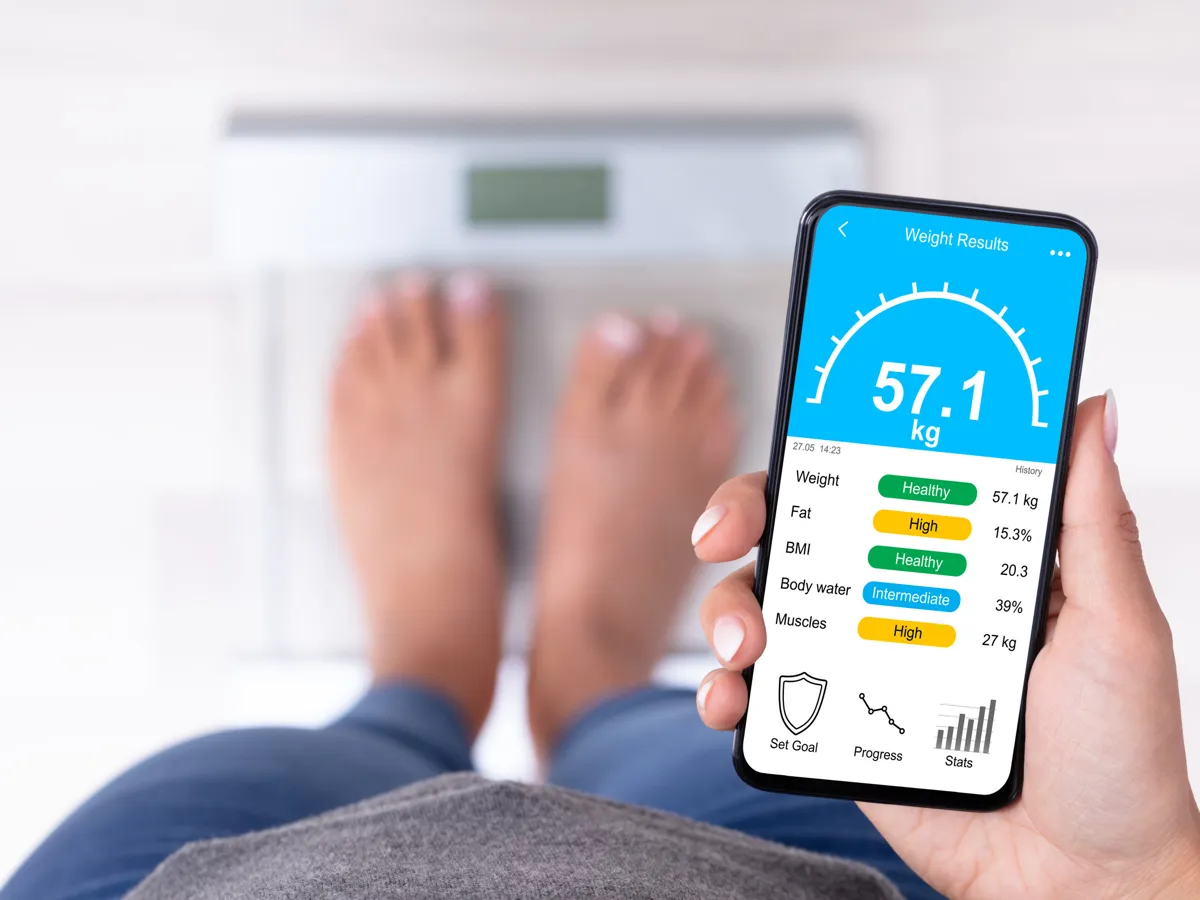
The short answer: if you only buy one thing, get a smart scale that saves every weigh-in to an app, so you see the trend and not just today’s number. Then add an inexpensive body tape. The scale can’t tell fat from muscle or water, so your waist measurement can show change the scale misses.
The other three each track one more piece. A phone tripod gives you progress photos you can compare. A food scale keeps your food log honest. A fitness tracker counts your steps.
None of these tools will change your body by themselves. What they do is show you that your habits are working, which is what keeps most of us going. Want to see where you’re headed first? Try the Body Visualizer, then use these tools to watch the real thing happen.
 If you only buy oneRENPHO Elis 1 Smart ScaleCheck price
 Best for when the scale stallsRayTour Retractable Body Measuring TapeCheck price
 Best for progress photosLiphisy 64-Inch Phone Tripod with RemoteCheck price
 Best for an honest food logEtekcity Food Kitchen Scale with BowlCheck price

RENPHO Elis 1 Smart Scale
The one to get first: it saves every weigh-in so you can see your trend.
- ShowsWeight, BMI, body fat
- In the app13 body measures
- HoldsUp to 400 lb
Step on and the scale shows your weight, BMI (body mass index, a number worked out from your height and weight) and body fat right away. RENPHO's app, connected by Bluetooth, keeps 13 body measures and lets you look back by day, week or month. That history is the whole point: one weigh-in tells you little, but a month of them shows where you're really going.
It can share your numbers with Apple Health, Samsung Health and Fitbit, so it works with the tracker below. RENPHO says it supports unlimited users, so the whole house can share one scale. It reads in 0.2-pound steps and holds up to 400 pounds.
What we like
- Saves every weigh-in so you see the trend
- Works with Apple Health, Samsung Health and Fitbit
- Unlimited users on one scale
Watch out for
- Body fat and the other body numbers are estimates. Use them to see which way you're heading, not as exact figures
- Body fat history and the 13 measures live only in RENPHO's app, so you'll set up an account on your phone
- Have a pacemaker or other implanted device, or pregnant? Read RENPHO's manual and ask your doctor before using it (see the note above)

RayTour Retractable Body Measuring Tape
Inexpensive, and it measures what the scale can't: where you're losing.
- Length60 inches
- MarksInches and cm
- LocksPush-button
A body tape shows what the scale can't: inches leaving your waist, hips and thighs. This one locks in place and pulls back with a push of a button, which makes it much easier to measure yourself with one hand than a floppy sewing tape.
It's 60 inches long, with large, clear markings in both inches and centimeters. Measure the same spots each week and write the numbers down.
What we like
- Locks so you can measure yourself with one hand
- Large, easy-to-read inch and cm marks
- Works for waist, hips, chest, arms, thighs and calves
Watch out for
- The tape starts at the 2-inch mark because of the locking part, so read it carefully the first few times
- Your numbers aren't saved anywhere, so keep them in a notes app or a notebook

Liphisy 64-Inch Phone Tripod with Remote
For full-length photos you can line up week after week.
- Height17 to 64 inches
- RemoteWireless, included
- HeadTilts and rotates
Photos can show change that numbers miss, but only if every photo is taken the same way. A tripod puts your phone at the same height and distance each time, and the wireless remote lets you stand naturally with your arms relaxed instead of stretching for a selfie.
It extends from 17 to 64 inches, made of aluminum alloy and stainless steel, and the phone holder rotates for a tall or wide shot. It works for videos and travel photos too.
What we like
- Same height and distance for every photo
- Wireless remote, so no awkward selfie arm
- Adjusts from 17 to 64 inches
Watch out for
- You'll need to mark where it stands, since moving it changes how your photos compare
- A tripod takes more room than a small stand; this one needs floor space

Etekcity Food Kitchen Scale with Bowl
For a food log you can trust, instead of guessing portions.
- HoldsUp to 11 lb
- Reads0.1 g steps under 1,000 g
- Unitsoz, lb, g, mL, fl oz
Most of us guess our portions low, and a food log is only as good as its numbers. A kitchen scale fixes that. Put your plate or bowl on it, press tare to zero it out, then add your food.
Etekcity's scale weighs up to 11 pounds, reads in 0.1-gram steps for anything under 1,000 grams, and switches between ounces, pounds, grams, milliliters and fluid ounces. It comes with a bowl that flips over as a cover for storage, and the display is backlit.
What we like
- Tare button lets you weigh food on your own plate
- Fine 0.1-gram steps for small portions
- Small, with a bowl that doubles as a cover
Watch out for
- It won't count calories for you; you'll still log the weight in a food app
- The extra-fine 0.1-gram steps stop at 1,000 grams; heavier food reads in 1-gram steps, which is still plenty

Fitbit Inspire 3
A simple, slim tracker for steps and sleep, the daily habits behind the change.
- TracksSteps, heart rate, sleep
- Exercise40+ modes
- PhonesiOS 16.4+, Android 11+
The Inspire 3 is a slim band that tracks your activity all day, plus your heart rate around the clock and your sleep each night. It nudges you with reminders to move, and it tracks workouts on its own, with more than 40 exercise modes.
It also tracks menstrual health and stress, and gives you a sleep score each morning. Its steps sync to the Fitbit app, and the RENPHO scale above can send your weight there too, so your numbers live in one place.
What we like
- Slim and simple, easy to wear all day and night
- Steps, heart rate and sleep in one app
- Reminders to move
Watch out for
- Calories burned on any wrist tracker are a rough guess, so don't eat them back
- Needs a phone with iOS 16.4 or Android 11 or newer
- Check Google's current Fitbit account and Premium subscription terms before you buy, since some features can depend on them
How to track the right way
- Weigh at the same time, the same way. First thing in the morning, after the bathroom, before you eat or drink, in the same clothes (or none). Food, water, exercise and even skin temperature change what a body-fat scale reads, so keeping things the same matters more than the scale you own.
- Watch the weekly trend, not one day. Weight goes up and down through the week. One study of daily weigh-ins found people were heaviest on Sunday and Monday and lighter by Friday, and called that normal. Compare this week’s average to last week’s.
- Measure your waist once a week. Stand up, wrap the tape around your middle just above your hipbones, and read it right after you breathe out, says the National Heart, Lung, and Blood Institute. A tip: keep the tape flat and snug, but not pressing into your skin.
- Take photos every two to four weeks. Same spot, same light, same time of day, same clothes. Put the tripod in the same place every time (a bit of tape on the floor helps), and take a front, side and back photo. Then look at them side by side.
- Pick a healthy pace. The CDC says people who lose about 1 to 2 pounds a week are more likely to keep it off.
What the numbers can and can’t tell you
- Body fat from a scale is a rough guess. Studies comparing home scales with a hospital DEXA scan found the average across a group comes out close, but one person’s reading can be off by several points either way. Use it to see which way you’re heading, not as an exact number.
- Your waist tells you something the scale can’t. The NHLBI says a waist over 35 inches for women, or over 40 inches for men, raises the risk of heart disease and type 2 diabetes. Watching it come down is a health win even in weeks when your weight doesn’t move.
- Calories burned on a tracker are rough too. A Stanford study of seven wrist trackers found none got calories burned within 20 percent. Steps are much closer: a review of 158 studies found Fitbit, Apple Watch and Samsung counted steps accurately in the lab. So count steps, and don’t “eat back” the calories your tracker says you burned.
- Steps are worth counting. A large US study followed adults aged 40 and up. Those who took 8,000 steps a day had about half the risk of dying during the study as those who took 4,000. It shows a link, not proof, but it’s a good daily goal.
- Guessing food portions usually comes out low. In a study of almost 1,900 adults at fast-food chains, people guessed their meal had about 175 fewer calories than it did, and bigger meals had bigger gaps. Weighing your food takes the guessing out of your food log.
How often should you weigh yourself?
Weekly works about as well as daily, a review of weight-loss studies found. Choose what feels good to you. In one six-month trial of 91 adults trying to lose weight, daily weighing didn’t harm mood or eating habits. But some research links frequent weighing with lower mood and self-esteem in women and younger people. If stepping on the scale makes you feel worse, weigh once a week or put it away for a while, and track your waist and photos instead. If you’ve ever had an eating disorder, talk with your doctor before you start.
Want to see what real change can look like? Read these before and after stories.
How we rate
We picked one tool for each way of tracking change at home: weight and body makeup, inches, photos, daily activity and food. Each pick is scored out of 10 on four things, weighted for a woman tracking her own progress: how well it does its one job (40%), going by what the maker says it measures and how; easy to use the same way every time (25%), because tracking only works when it's consistent; app and sharing (20%), including whether your numbers can sync with other health apps; and value (15%).
We have not tested these tools ourselves. We read every bullet of each maker's Amazon listing, and a scale maker's own safety pages for the body-fat warning. A product needed thousands of ratings to make the shortlist, but we don't quote reviews or star ratings. No brand pays for placement, and a commission cannot buy a higher rating. When a pick changes, we will say so on this page.
Frequently asked questions
Do I need an app or an account to use a smart scale?
For anything past today’s reading, yes. The RENPHO shows your weight, BMI and body fat on the scale itself, but your history and the other measures live in its phone app, which needs an account. If you’d rather not share health data, you can read the scale and write the number down, and lean on the tape and photos.
Which is better for tracking: the scale or the tape?
Use both. The scale is quick and shows your overall direction. The tape shows where you’re losing. Neither one tells the whole story alone, so a week where one doesn’t move isn’t a bad week.
Sources
- NHLBI (NIH): Assessing your weight and health risk (how to measure your waist; 35 and 40 inch thresholds)
- CDC: Losing weight (1 to 2 pounds a week; talk with your health care provider)
- Withings: Body Comp, frequently asked questions about safety (pacemakers, implants, pregnancy)
- NIH Technology Assessment Conference: Bioelectrical impedance analysis in body composition measurement (Am J Clin Nutr, 1996)
- Bosy-Westphal et al.: Accuracy of bioelectrical impedance consumer devices compared with DXA (Obes Facts, 2008)
- Orsama et al.: Weight rhythms, weekly weight changes (Obes Facts, 2014)
- Madigan et al.: Self-weighing in weight management, a systematic review and meta-analysis (2015)
- Steinberg et al.: Daily self-weighing and adverse psychological outcomes, a randomized trial (Am J Prev Med, 2014)
- Pacanowski et al.: Self-weighing, throw out your scales? (review, 2015)
- Fuller et al.: Reliability and validity of commercially available wearable devices, a systematic review (2020)
- CDC: About BMI (BMI does not distinguish between fat, muscle and bone)
- Shcherbina et al.: Accuracy in wrist-worn sensor-based measurements of heart rate and energy expenditure (J Pers Med, 2017)
- TechLiving: The best smart watches for fitness tracking (five picks, if you want a watch instead of a band)
- Saint-Maurice et al.: Daily step count and mortality among US adults (JAMA, 2020)
- Block et al.: Consumers’ estimation of calorie content at fast food restaurants (BMJ, 2013)